Odin Again Lent Hermod His Swift Horse Sleipnir and Also Gave Him His Runic Staff
Sleipnir is the eight-legged equus caballus ridden primarily by the god Odin in Norse mythology. He is the son of the god Loki (in the course of a mare) and the stallion Svadilfari who belonged to the jötunn that built the walls of Asgard. In Republic of iceland, the glacial canyon Ásbyrgi is known equally Sleipnir'due south Footprint in the horse'due south honor.
According to legend, the great equus caballus, conveying Odin, rode through this expanse and one of his hooves landed amongst a wood, creating the coulee. This story is typical of tales concerning Sleipnir, which often draw him as immensely large, carrying Odin through the realms where some testify of their passage is left behind. In other stories, he seems only slightly bigger than an average equus caballus, only with eight legs.
Sleipnir is e'er depicted as incredibly swift and the "best of all horses", symbolized by his viii legs that conduct a rider anywhere in the nine realms of Norse cosmology in record time. Since he was born of two supernatural entities, he is possessed of the power to move easily between realms, including the realm of the expressionless, leading to his name (pronounced Slayp-near), which ways "the sliding one".
In Scandinavian civilisation, horses were understood every bit possessing supernatural abilities that placed them in communion with the gods & spirits.
Although he is near ever ridden by Odin, in the story of the decease of the god Baldr, he is ridden to the realm of Hel in the afterlife by Baldr'south blood brother Hermóðr. Sleipnir is able to easily jump the high fence around Hel and then bring Hermóðr safely back to the gods at Asgard. The great horse likewise features in the tale of Odin's race with the giant Hrungnir who is killed past Thor when he threatens the Asgardians.
Sleipnir's final ride is to carry Odin to the battlefield of Vigrid at Ragnarök, the Twilight of the Gods. In the last battle between the forces of chaos that include Loki and Sleipnir's half-siblings Fenrir, Jörmungandr, and Hel – among others – on the side of chaos, near of the Norse gods are killed, including Odin and his faithful horse. Sleipnir is then thought to conduct Odin to the afterlife in keeping with the traditional agreement of the horse a liminal being in Norse mythology.
Horses in Norse Belief
In Scandinavian civilisation, the stallion replaced the balderdash equally the symbol of virility and power, but horses generally were understood every bit possessing supernatural abilities that placed them in communion with the gods and spirits. There was no clergy in Norse religious practice, but there was the effigy of the völva (seeress), a woman who received letters from the gods, could predict the future, and presided over community rituals. The völva was highly respected, merely information technology was recognized that horses were closer to the gods and could understand them better than any völva. Scholar H. R. Ellis Davidson comments:
The equus caballus was an beast which could exist associated with the journey sun and it was an important religious symbol in the North from the Bronze Age onwards. A horse could carry a departed hero to the realm of the dead and is shown doing this on many of the memorial stones set upwardly in Gotland in the Viking Historic period. Like Freyr's boar, Odin's horse traveled swiftly though the sky and down into the realm of death. In the beginning century Ad, the sacred horses of the Germans were held to understand the will of the gods more clearly than their priests could practice, co-ordinate to Tacitus, and so that they were used for divination. (53)
The divination took the form of harnessing a horse, or horses, to a chariot or railroad vehicle and and then observing the path they took, unremarkably between spears or other projectiles set on the ground in front end of them. Although there are no stories of Sleipnir predicting the future overtly, he is thought to be quite intuitive, knowing the fastest way to reach a destination to minimize risks to his passenger.
Sleipnir's Eight Legs
Sleipnir is first mentioned past name in 10th-century Eddic verse which was amidst the sources used by the Icelandic historian and mythographer Snorri Sturluson (50. 1179-1241) for the Prose Edda, a unified narrative of Norse myths written in the 13th century. The eight-legged horse as a shamanic symbol of transformation, however, predates Sleipnir'southward name (at least in writing) as Gotland rune stones feature the image of Odin on the eight-legged horse arriving in the afterlife equally early equally the 8th century.
Sleipnir'southward famous eight legs have been claimed by some modern-twenty-four hours writers to be a consequence of his magical nativity which left him deformed, just scholars reject this claim noting that they were probably imagined to convey the concept of speed. Scholar Rudolf Simek, for case, points out that, "on the Gotland stones, the viii legs simply serve to give the impression of speed and the pictorial tradition paved the way for the eight-legged horse in literary tradition" (293-294). Simek as well claims that the story of Sleipnir'due south magical birth is well-nigh likely an invention of Sturluson who added his ain imaginative touches to many of the Norse myths.

Odin on Sleipnir (Tjängvide image rock)
It has as well been suggested that the eight legs symbolize cosmic balance and transformation, besides as suggesting stability, and while this may be true, the original intent seems merely to advise speed. Sleipnir is later known equally the antecedent of the great hero Sigurd's horse, Grani, also known for his speed and referred to every bit "the all-time of horses", so speed was conspicuously central to the horse's attributes.
Magical Birth
Sleipnir is as well mentioned in the diverse works that make up the Poetic Edda, notably Baldrs Draumar ("Baldur's Dreams") when Odin rides him to the realm of Hel to ask the spirit of a witch what his son's dreams portend. His origin story comes from the Prose Edda in the tale of the construction of the walls of Asgard and Valhalla.
After the gods had created and ordered the Nine Realms, they set up virtually building a protective wall around their home of Asgard and the Hall of Heroes, Valhalla. While they are discussing how best to go well-nigh this, an unnamed man appears and offers to do it for them in exchange for the goddess Freyja, the sun, and the moon. The gods are not eager to accept the proposal, just Loki, the trickster god, talks them into it. The gods place stipulations on the agreement, notwithstanding, that the master-builder must complete the walls in three seasons (spring, summertime, fall) and must do then without the help of any other homo. The builder asks if he can use his equus caballus, Svadilfari, to assistance, and, again later on Loki's influence on the discussion, the gods agree.
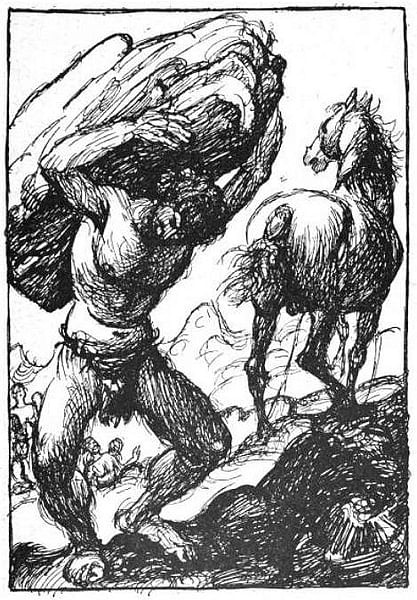
Svadilfari and his Master
It chop-chop becomes apparent to them that Svadilfari is no ordinary horse as he can movement stones from great distances faster than any man could. With his horse's aid, the builder has most completed the walls days before the borderline. The gods are not interested in paying what he asked and turn on Loki as the one responsible for the understanding. They tell him that he must gear up this or face the worst death they can devise for him.
Loki transforms himself into a cute mare and, that night, trots out to where Svadilfari is moving stones. The stallion is instantly attracted to the mare and runs toward her, simply Loki-as-mare bolts away into the woods. The architect runs afterwards Svadilfari, chasing him all night, then the wall is not completed by the deadline. The gods discover that the builder is a jötunn – a citizen of the realm of Jotunheim, land of the frost giants – who are enemies (or at least on uneasy terms) with the gods of Asgard. They phone call on Thor to take care of this problem for them, and he appears, smashes the builder'southward skull with his hammer, and that ends the difficulty the gods' faced of the builder perhaps objecting to not-payment. Loki-as-mare, meanwhile, has been finally brought to ground past Svadilfari and impregnated, subsequently giving nascency to Sleipnir.
Odin'due south Race
Odin took Sleipnir equally his own, every bit primary of the gods, and rode him throughout the Nine Realms on his diverse journeys. I twenty-four hour period, he rides in Jotunheim and encounters the giant Hrungnir who admires Sleipnir. Odin boasts that his horse is the all-time to be found anywhere, and Hrungnir is annoyed, challenge that his ain equus caballus, Gullfaxi ("Golden Mane") is better and faster.
Thor gives Magni Gullfaxi and so that at present the two greatest horses in the Nine Realms both reside in Asgard.
Odin challenges Hrungnir to a race, and the two gear up off galloping on their horses toward Asgard. The Asgardians have no interest in allowing a jötunn inside their walls, simply Gullfaxi is and so swift that he is right on Sleipnir's tail and Odin wins by but a hairsbreadth. Feeling he must offering hospitality, he offers Hrungnir a drink, which the behemothic quickly drains and so calls for more than.
Hrungnir becomes drunk and begins threatening the Asgardians. He roars that he volition kill them all, destroy Asgard, and take Odin's Hall back to Jotunheim as a prize along with the beautiful goddesses Freyja and Sif, Thor's wife. Hrungnir has already (at some point) kidnapped Thor's daughter Thrud (later returned or, peradventure, escaped) and so he is hardly well-regarded even before he begins his drunken rant. The gods call for Thor who challenges Hrungnir to a duel and smashes his skull with his hammer just as he did with the builder of the walls of Asgard.
The giant falls and his leg lays across Thor'southward throat. None of the Asgardians are strong plenty to elevator information technology except Thor's 3-year-former son Magni who rescues his begetter. As a reward, Thor gives Magni Gullfaxi so that at present the two greatest horses in the Nine Realms both reside in Asgard.
Expiry of Baldr
Sleipnir is too featured in one of the nearly famous pieces from N mythology, the tale of the death of Baldr. Baldr was the son of Odin and his wife Frigg and was considered the most beautiful, the kindest, and wisest of the gods. In the poem Baldrs Draumar from the Poetic Edda, Baldr begins having nightmares of some impending doom. Odin mounts Sleipnir and travels to Hel, the realm of the expressionless, to find out what the dreams mean.
Hel is surrounded by a high wall to proceed the dead in and the living out, but Sleipnir is able to hands travel between realms then brings Odin directly inside. There he notices that Hel has been cleaned and swept, the floor covered in gilded, the benches newly laden with fresh hay for seating. He summons the spirit of a völva (given equally "witch" in some translations) and asks her what this ways. She tells him that Hel has been prepared to welcome the soul of Baldr who is shortly to get in.
The poem ends with the völva telling Odin to return to Asgard as he will be in Hel himself soon enough subsequently Ragnarök, merely the tale is connected in the Prose Edda in Department 49 of the Gylfaginning where Frigg, upset at the prospect of losing her son, goes throughout the Nine Realms extracting a promise from all things animate and inanimate that they will not harm Baldr.
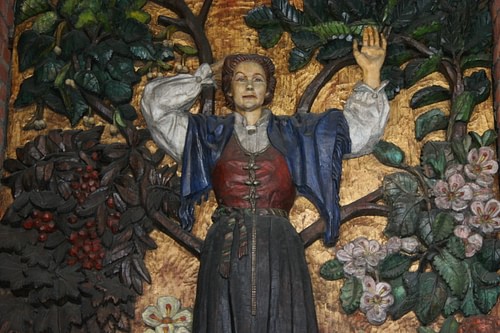
Frigg
Baldr is universally loved and so the promises are given hands. Afterward, the gods of Asgard accept up the sport of hurling objects at Baldr to watch them bounce harmlessly off in accordance with their pledge. Loki watches this game one 24-hour interval and, deciding to cause trouble, transforms himself into a woman and goes to visit Frigg in her palace at Fensalir.
Frigg asks what the Asgardians are up to, and the adult female tells her that they are at their usual sport of lobbing all kinds of things at Baldr. She and then asks the queen if it is really true that all things in the Nine Realms took the oath to protect him, and Frigg innocently replies that she never asked the mistletoe because information technology was so immature and harmless. Loki instantly leaves, finds some mistletoe to the due west of Valhalla, and brings information technology to Asgard where he sees Baldr's blind brother Hodr standing to the side of the festivities, feeling sad because he cannot participate. Loki tells him he volition guide his aim and Hodr flings the mistletoe which pierces Baldr, killing him instantly.
The gods are devastated by his death and Frigg appears, weeping over her son, and asks someone to ride to Hel and inquire for Baldr'south return. Hermodr, Baldr'southward blood brother, volunteers, and Odin saddles Sleipnir for him. Hermodr rides for 9 nights downwards the descending route to Hel, crosses the span above the river of spears, and is told he cannot enter because he is a living being. Sleipnir hands jumps the walls of Hel, however, and Hermodr finds Baldr'south spirit being entertained grandly in a great hall in the presence of Hel, Queen of the Dead, and Baldr's wife Nanna, who has died of grief since Hermodr left Asgard.
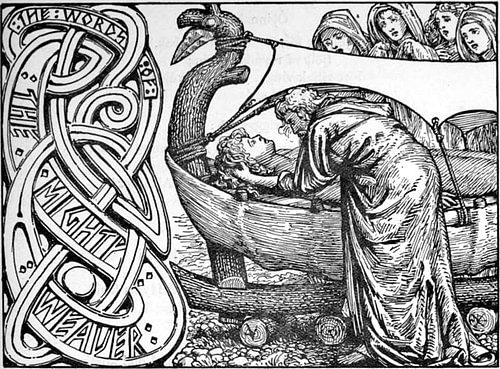
Odin's Last Words to Baldr
Hermodr makes his request, and Hel agrees to render Baldr and Nanna if all the Nine Realms shall weep for him. Hermodr rides Sleipnir out of death's realm and back to Asgard, and all the realms do weep for Baldr except for the giantess Thokk (who is actually Loki in another form), who claims the dead belong with the dead. Baldr must remain in Hel's realm until the terminate of the present world at Ragnarök.
Ragnarök
Ragnarök had been foretold by the Norns – the Fates whose visions could not be contradistinct – and was the end of the Nine Realms and many of those who lived in them. It was the final great boxing between the forces of anarchy and those of lodge and would be heralded past Sleipnir's one-half-brother, Fenrir, the bang-up wolf. First would come a breakdown in man relationships and a failure to honor traditional customs, and and so three astringent winters, without summertime between, would bring famine to the lands. Fenrir, spring by Odin and the Asgardians to a rock on an island, would break his bondage and rampage through the realms while his son Sköll swallowed the sun and his other son Hati took the moon.

Odin fighting Fenrir
Sleipnir's other half-brother, Jörmungandr the World Ophidian, rises from the ocean sending tidal waves through the realms while his half-sister, Hel, provides an army of the dead to her father Loki who brings Surtr and his fellow ire giants to the battlefield. The gods of Asgard with the fallen heroes of Valhalla confront the forces of chaos in the bang-up battle where Odin charges against Fenrir on the back of Sleipnir. The dandy wolf devours them both and is then killed by Odin's son Vidarr. Most of the gods dice in the battle, including Thor and Loki, but the forces of order are victorious – fifty-fifty every bit Surtr and his giants set the Nine Realms ablaze – and a new world eventually rises from the ashes.
Decision
Sleipnir is never depicted just as Odin's horse but rather every bit his companion who shares in adventures. His death with Odin in the final great battle echoes not just their human relationship simply likewise the way a Scandinavian or Icelandic audition would take understood horses: as liminal beings able to bridge the space betwixt the land of the living and that of the expressionless.
Horses were oftentimes included in Norse burials as they were considered essential to one'south afterlife, merely, as with dogs, they were also understood as guides who would bring the soul of the deceased safely to its destination. Lindow notes how this concept is made clear non only through excavated graves and tombs but too by the Gotland stones:
Some of the eighth-century moving picture stones from the island of Gotland show eight-legged horses, and most scholars accept that these represent Sleipnir. A rider sits on each, and some scholars recall this is Odin; indeed, above horse and rider on the Alskog Tjangvide stone is a horizontal figure with a spear, perhaps a Valkyrie. A adult female greets the passenger belongings a loving cup and the entire scene has been interpreted as the inflow of the passenger in the globe of the dead. (277)
Sleipnir falls in battle with Odin because he had to in social club to ensure his friend reached the other realm safely. The horse was ever understood to be in tune with the will of the gods and, through them, with the vibrations of the Universe, always knowing the swiftest way to any destination and ever vigilant of their rider's safety. This idealized vision of the equus caballus is epitomized in Sleipnir who is praised as the best of all horses not but for his speed but his devotion to the i he carries.
This article has been reviewed for accurateness, reliability and adherence to academic standards prior to publication.
Source: https://www.worldhistory.org/Sleipnir/
0 Response to "Odin Again Lent Hermod His Swift Horse Sleipnir and Also Gave Him His Runic Staff"
Post a Comment